
Spring 2026 Happenings


April and May have been quite busy months for local living history and for me personally. From Fort Harker to the CMP to Strieght’s Raid, and Resaca, members of the 31st Alabama and Hardee Guard have been very active across both Alabama and Georgia. Personally, this has been the most challenging and interesting time of the year as I am completing another year of secondary classroom instruction, preparing for a career transition, and I am in the final stages of my dissertation process for my Ph.D. I believe I will reflect on this time with great admiration for the many who have been supportive of my efforts and have assisted with my research and data collection. I am quite blessed to be part of the living history community in which I am. It consists of so many wonderful people that are in many ways selfless and highly dedicated to not only the preservation of our history and heritage, but also one another.
Fort Harker
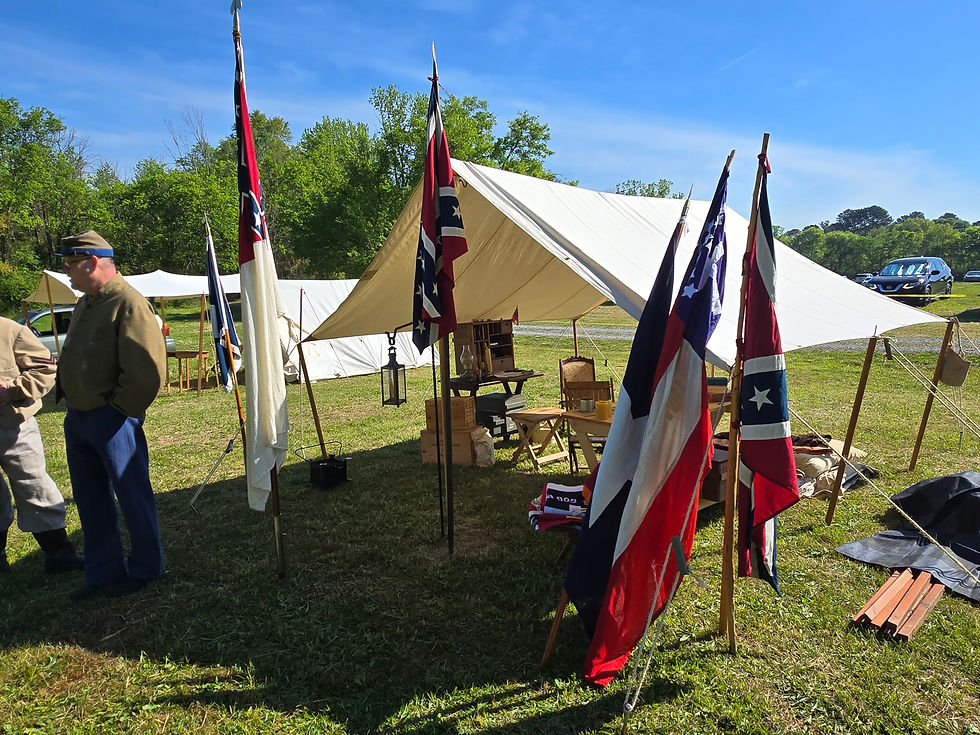
Fort Harker was perhaps the largest it's been this year. A large overall turnout in addition to the greatest number of federal infantry I have seen at the event. The battalion was quite outnumbered each day and this year was the first year in which the second day’s assault failed to reach the fort itself. However, most importantly, this event served as host to the completion of most of the collection of my research for my Ph.D. as I spent hours collecting interviews from fellow living historians. To say that I am both humbled and greatly appreciative of their willing participation in my work is an understatement. Again, I am proud to be part of a community that looks after each other and supports one another.

School Days for the event saw some 500 students from as far away as Tennessee attending our program and cycling through each of the stations. For this particular program, I hosted a flag demonstration and spoke on the different banners found throughout the Army of Tennessee in the war. I also showed an example of colors issued to regiments in the Army of Virginia to give each group an idea of the difference in the size and shape of the battle flags used by the Confederacy in each theatre.

This served additionally, as an excellent opportunity to dispel the mythology or misidentification of the “Stars and Bars” of the Confederate States of America, as most folks today inaccurately identify the St. Andrews Cross on the battleflag as such. I also spoke on the differences behind the design and the reasons which contributed to some of the symbology used. Further, I addressed the reason behind the use of regimental colors and how they were used to communicate direction to the men in the confusion of the battle when engaged on the field.

As for the skirmish, the Federal infantry at this year’s event, would have a numerical advantage each day; further, they looked quite sharp, and maneuvered very well on the field. I was quite impressed with the turnout. The first day’s skirmish would begin with Confederate infantry positioned on the bank of the Tennessee River, moving in skirmish order towards the fort (from the southeast). The Confederate infantry would consist of four companies mostly of the Hardee Guard Battalion, these being the 48th Alabama, 31st Alabama, 34th Georgia, and men from both the 37th and 3rd Tennessee. The 34th GA was placed on the left flank of the elongated line, with the 48th AL on the right and the 31st AL and 37th/3rd TN in the center. The 34th GA would work the edge of the field approaching the fort and pushing off attempts to flank the Confederate line by Federal Skirmishers. Meanwhile the 48th would engage the main column of the Federal advance, delivering a push on its flank and driving the force from the field and to the outskirts of the fort. The center of the Confederate line would additionally be used to push on the fort, capturing the Federal Artillery’s position just outside of the fort and pushing on the fort itself. Here the scenario would find its conclusion as the remaining federal infantry would be decimated by overwhelming fire from both its front and left flank.

The second day would be a much different scenario as the Confederate battalion would enter the field in battalion formation and approach the fort from the east. Here resistance from a superior Federal force would make crossing the ground quite difficult. Further, losses would eventually slow and then halt the progress of the Battalion’s advance across the ground, resulting in the failure of the battalion to push the enemy from their position. The loss of both senior level Battalion officers would additionally result in the capture of my sword, given the futile situation in which the Battalion would be faced on pressed on its front and left flank. With the surrender of the sword came the conclusion of the second day’s scenario, a first in the history of the event in which the Confederate forces failed to reach the fortifications.

Outside of the scenario, the event was quite pleasant and a welcome return after a long restful winter with few events happening in the time between. It was a great event in which to “knock off the dust” from one’s boots. The event has also served to set the pace for the remainder of the season, as we’ve had a quite busy and productive season.
Confederate Memorial Park

Following the event at Fort Harker, I attended the Confederate Memorial Park, and decided to go not as an officer, but as an enlisted man. This was a nice change and created an opportunity for me to use my 1862 Austrian Lorenz, which has since become my favorite of my originals to use at an event. While at the park, I conducted a few additional interviews for my research while also taking time to rest. Additionally, I visited the museum at the park, which is always a must visit when there. I am proud to say that I also received a few faithful copies of Harper’s Weekly for my displays which were very nicely recreated. This was one of the highlights of my trip actually.
Regarding the skirmish, it was a rather small affair, but was well done and for what it was, it went well I thought. We held this brief scenario on the site of the former veterans home itself. Given the numbers we had, it was a good use of the space and provided adequate room for some skirmish order fighting. The scenario would call for the gradual withdrawal of the Federal detachment from the site, with heavy losses occurring against a numerically superior Confederate home guard pushing from the north of the federal position.
Prior to the scenario or skirmish, the park had played host to visitors for much of the morning. Those visiting would come through the period barracks and would further ask questions about our arms and equipment. I fielded several such questions from multiple people curious about why we used some of the items we have and why jackets are still worn in hotter weather. Additionally, amongst the parade ground at the barracks were arranged different stations with information pertaining to different topics regarding the war, such as shelter, signal corps, flags, cooking, and of course, the barracks serving as a physical representation of soldier lodging in the period, and lastly, an infantry drill on the grounds and firing demonstrations for those visiting. The educational value of this undertaking is quite high and it is a unique environment for such an undertaking.
Straight’s Raid

Streight’s Raid was a wonderful event this year. We were treated to wonderful weather and to a great skirmish both days of the event as well as fellowship and excellent turnout. I stand quite appreciate of the Cherokee Battlefield Preservation Corporation for their continued work on the property and the quality of the event which improves with each passing year. This year we were introduced to the new memorial wall which is sponsored by the local chapter of the United Daughters of the Confederacy. The wall’s initial concept is meant to honor the ancestors of the living historians who participate in the event each year on one side, while commemorating the living historians or those within the community on the other side. Each side will feature bricks with the names and the unit of the ancestor/living historian to be featured. The bricks cost 75.00 each and I personally purchased two, one for my ancestor in the 52nd Ga. Company A, Thomas Anderson Kimbrell, and then the second I purchased was for myself to read: Jason A. Sumner, Major, 31st AL Inf. / Hardee Guard Battalion, and on the bottom of each brick a third line of text will read “Deo Vindice.”
The 31st Alabama additionally purchased two bricks, one for our late Major, Gary Lee, who passed away unexpectedly six years ago, and one for our recent Colonel Scotty Myers, and his late wife, Tammy Myers. Each of whom played a critical part in the formation of our company and contributed greatly to the hobby and our understanding of our place within. The membership of the company agreed that the best way to continue to honor them was the placement of a brick on the wall of honor. I am proud of the company for honoring them in this way.


As for the event, the scenario is based upon the trickery of General Nathan Bedford Forrest, who quite literally fooled Able Streight into surrender, deceiving him into believing that he was outnumbered and surrounded. The interesting fact about the event is that it takes place on the actual site of the surrender of straight. We simulate this situation on the second day of the event with two living historians recreating the surrender as General Forest and Col. Streight. If you have not had an opportunity to read on this event, I would certainly suggest that you do so as it is a quite fascinating event in the annals of the war’s history.
The temperature for the event could not have been better, as we ended up with a beautiful weekend, and excellent breeze which kept the camp and property quite pleasant given our wearing of federal blue which can become quite warm and unpleasant quickly. We further enjoyed plenty of shade given the area in which we typically camp. I will very much look forward to the event next year as I believe the wall will be underway. This particular and unique event presents an opportunity to continue telling Alabama’s story from the war and it is most desire and hope that this event will continue to grow and prosper as we seek to share our past with those interested.
Resaca

Sunday of Resaca was the best scenario I have seen in my time within living history. Memories were made over the course of this event and I am quite proud of the way in which the battalion and company performed. This event will be a memorable event for many reasons, and I very much enjoyed attending this year. To recap the event, I arrived on Thursday morning, which was the earliest I have ever arrived at this event. I do not regret my decision to arrive early as I had time to explore the original earthworks, which were figuratively less that 200 yards from our encampment, and as I had ample time to relax and enjoy the great outdoors after establishing my camp. I found the weather to be the best it had been all year with a slight and constant pleasant breeze for most of the day.

My visit to the works was by happenstance, as I had mentioned to the Colonel that I had yet to see them (surprisingly) in all the years I had attended this event. The Colonel and I were driving around the field reviewing the scenario and troop movements, which then prompted him to drive to a smaller field to the rear of the camp. This particular field rests at the bottom of a ridge, and once at the tree line, we got out and began a short hike to the top of the ridge. Here we located the end of the earthworks that had been located here some. They lie at the top of the ridge and run for some distance to the east of this position as this was their end.
I was quite pleasantly shocked with how well preserved and how distinct they were given the course of time and lack of preservation of any kind. I attribute their condition to lack of disturbance given their remote location in the wooded area. The only trace of human interaction evident was a deer stand that stood peacefully above them, giving the impression that the local deer must frequent the area often.

By Friday evening the majority of the company had arrived in camp and began to set up for the weekend. The camp was quite a lively place with the arrival of so many people. I enjoyed the fact that I had ample time to catch up with so many friends that I had not seen in a while. This however was interrupted by my duties, as I had meetings to attend.
The Battle of Franklin Event
At the officer meeting for Resaca, we were informed by the Atlanta Campaign Committee Chair, that the location for the Battle of Franklin (originally scheduled to be in Lebanon, TN) had been relocated to Lafayette, Georgia, the site of the Chickamauga 165th Event two years ago. Though a surprising development, the news was welcome as it means the event is going to take place due to contingent planning by the event coordinators. The land owners of the original site decided to back out of the event, and informed the committee two days prior to the Resaca Event. I stand extremely appreciative of the gentleman of the Atlanta Campaign as they have worked hard to create quality events for our community over the years. They always create excellent quality events and I very much look forward to this event scheduled for this upcoming October, regardless of where it is held.
Saturday Morning Parade
Saturday morning began with morning parade, a wonderful tradition at Resaca, in which both Federal and Confederate forces meet for the raising of the colors, announcements/orders, trooping of the line, and for other purposes, such as honoring those who we have lost since the last Resaca Event this past year. This particular ceremony included the ringing of a bell 12 times, a moment of silence for each of the 12 men honored and prayer. Following the morning parade, each force was dismissed, with some moving on to drill and others to enjoy the wears of the sutlers. The 31st AL opted to conduct drill in the small field I previously mentioned. As I did not attend their company drill, I am not too sure of what they worked on; however, I believe a good bit of it was school of the soldier and basic commands with some basic practice of movement in line ahead of the battle as the company had a number of new faces within the ranks.
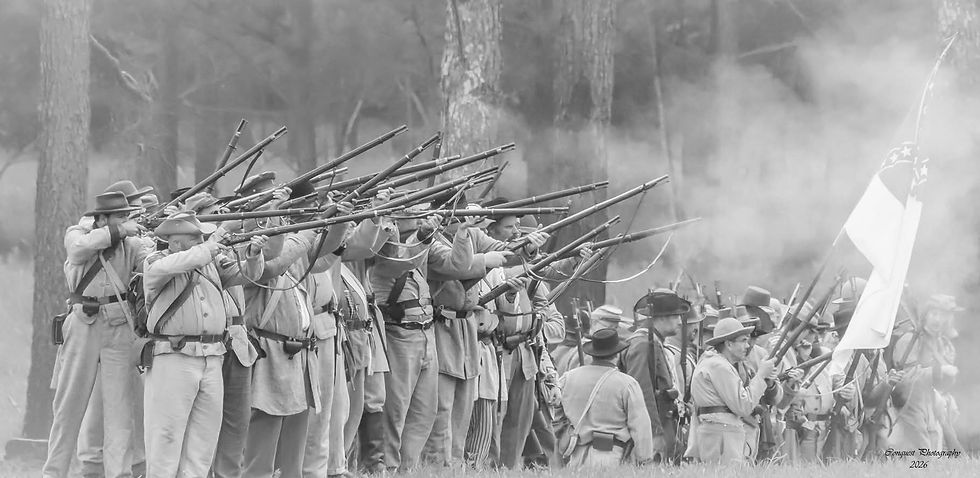

The battle on Saturday was said to be possibly one of the best the spectators had ever seen; however, the perspective from the field was that of confusion as we were unclear regarding pace and tempo of the scenario and had to react to an unforeseen circumstance regarding the placement of the flying battery’s placement on our left. This created a situation which changed the scenario as we could not oblique the battalion into the woods and earthworks as instructed and it greatly reduced our effective area of operation. Hence, we moved straight forward and across the ground despite the obstacle and eventually were driven back and off of the field. Our confusion given the situation was never known to those spectating and from what we were told, their perspective revealed a large line of grey advancing across the field and then being repulsed.

The battle on Sunday will be remembered, as our taking of the federal position on the earthworks to our left was the most adventurous and spontaneous thing in which I have witnessed in the field. There are moments in which some describe seeing the “elephant,” this phrase meaning that one has a moment in which the reality of what they are seeing leads them to feel as if they are in that moment from 160 years or so ago.


This possibly was the closest I have had to such a moment. Obviously, I understand that I will never truly understand what those men saw or felt; however, in our vain attempts to recreate for the public, a scene or situation, so that the public can clearly understand and interpret the past, we sometimes find moments of immersion which surprise us and serve to inspire us. This was clearly one of those moments for me as the confusion and the order of the battalion drifted away in the boys' haste to push the Federals from those works and then from the thicket beyond. The confusion amongst the panic of gunfire was a truly real thing, and it made clear to me, that the written accounts of such from the war are quite valid and were not hard to achieve. We did not regain the battalion’s composure until we had damn near ran the Federals up the opposing ridge on the clear opposite side of the battlefield. This scenario will clearly inform my memory for many years to come and will be one of those signature events to talk about in future years as it has the makings of a grand memory to be shared.
A Fond Farewell

Resaca this year will stand out to me for a number of reasons, particularly given the nature and feel of this year’s event. However, it will forever memorialize the loss of dear Mrs. Tammy Myers, the beloved wife of our former Colonel, Mr. Scotty Myers from the 1st Division of Southern Reenactors Association. Both of these individuals have endured a grand number of health-related hardships in the past few years, and it has been heartbreaking to witness. Each of them loved the company, they loved the history, and were wholly dedicated to advancing education about our past and did so with elegance, grace, and pride. I stand appreciative of them for the example they established for our members and myself. Tammy was one of the kindest people I have ever had the fortune to come across and she very markedly was the example of a southern belle. I will very much think fondly upon the memories I have from time well spent with each of them over the past years in my journey through living history. To Colonel Myers, and their family, I offer my sincerest condolences regarding the loss of such a wonderful human being. May God bless them with comfort and may he embrace Tammy in eternal peace.


Comments